Electronic Air Suspension Calibration
The Discovery's electronic air suspension system requires precise calibration after any suspension work, including spring replacement, compressor fitting, or height sensor adjustment. On the L462, Pathfinder provides the ride-height calibration routine, which must be performed on a level surface with the vehicle unladen. The L319 uses SDD for the same procedure, with the additional requirement that the diagnostic session remain active during the full calibration cycle. Incorrect calibration can lead to uneven ride height, adaptive damping errors, and fault codes in the suspension control module.
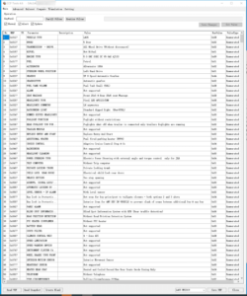
It is also possible to adjust the default ride height and access height settings via CCF Editor on both generations. This is particularly useful for vehicles that have been fitted with aftermarket suspension components or raised for off-road use. Always save the original CCF before making any suspension-related changes, as incorrect values can trigger limp-home mode and disable the air suspension entirely.
Terrain Response System Optimisation
Terrain Response on the Discovery is one of the most sophisticated off-road systems in any production vehicle. The CCF Editor allows workshop technicians and enthusiasts to modify the default behaviour of each Terrain Response mode. On the L462 with Terrain Response 2, you can adjust the throttle response curves, traction control intervention thresholds, and differential locking strategies for each of the auto, grass/gravel/snow, mud/ruts, sand, and rock crawl modes.
For the L319, the earlier Terrain Response system offers fewer adjustable parameters but still supports significant customisation. Common modifications include disabling the automatic mode selection on manual transmission models, enabling the extended rock crawl profile on automatic vehicles, and adjusting the hill descent control speed increments. These changes require a clear understanding of the vehicle's drivetrain and should only be performed by experienced technicians or under remote guidance.
Towing & Trailer Module Configuration
Once a tow bar is physically fitted, the Discovery must be configured to recognise the trailer electrical module. On the L462, this involves coding the trailer control module, enabling the tow hitch option in the CCF, and updating the rear electronic module to support the trailer lighting harness. The L319 follows a similar procedure through SDD, with the additional step of configuring the trailer stability assist system if the vehicle is equipped with the advanced driver assistance package.
Beyond basic lighting recognition, the towing configuration can also enable trailer reverse guidance, which overlays the predicted trailer path on the surround camera display. This feature is available on L462 models with the 360-degree camera system and requires both the camera module and the trailer module to be correctly coded. The maximum trailer weight and tongue weight values can also be adjusted in the CCF to match the installed tow bar rating, ensuring the vehicle's stability control and braking systems operate within safe parameters.
Driver Assistance System Calibration
Modern Discovery vehicles are equipped with an extensive array of driver assistance systems, including lane keep assist, traffic sign recognition, and driver condition monitoring. After windscreen replacement or camera module replacement, these systems require calibration using a diagnostic tool. On the L462, Pathfinder provides the guided calibration routines for the forward-facing camera and the surround camera system, which must be performed in a controlled environment with the correct calibration targets.
The L319's earlier driver assistance systems, including the parking distance sensors and the rear-view camera, also require calibration after component replacement. SDD provides the necessary routines for these systems, though the process is less complex than on the newer models. In both cases, it is essential to clear all existing fault codes before starting the calibration, as unresolved faults can prevent the calibration routine from completing successfully.